Friday, 2 November 2012

Polar Bears and other drumming

And as for my favourite drummer -Sebastian Rochford. I'm losing count how many times I've seen him, having seen Polar Bear, Rochford's own band, several times; plus Basquiat Strings featuring him on drums; plus Ingrid Laubrock Quintet; also Seb and Andy Shepherd at Snape Maltings at the end of a week's residency, where they had been composing together.

Polar Bear's 'Held on the Tips of Fingers' was nominated for a Mercury award in 2005, as was Sebastian himself in 2007 for 'Basquiat Strings with Seb Rochford'. He is part of the F-IRE collective, which includes the Basquiat Strings and Laubrock.
The line-up of Polar Bear of two saxophonists (Pete Wareham and Mark Lockhart, who also play with Rochford in Acoustic Ladyland) double bassist Tom Herbert, and Seb on drums, was added to by Leafcutter John with assorted electronica in 2004.

Watching Seb is magical, he continually experiments and looks as if  he is as surprised with the results as the audience. This sense of wonder is accompanied by a quiet, intense stage presence, where he charms the crowd with what appears to be an innocent naivety and gentle sense of humour which extends to titles of tunes, which seem to be continually developing, such as 'Fluffy (I want you)'. He recounts how he wrote a tune when his girlfriend was leaving him, then qualifies this with, well not as she was ACTUALLY leaving, or he wouldn't have been paying attention. And of course there's the famous hair and elfin features, which somehow belie his years.I met him when I was helping with a local jazz club, and he was the only performer who helped me put away the chairs at the end, quietly chatting.

Apparently recently he has been working with Herbie Hancock and Corinne  Bailey  Rae, and in the past has worked with David Burne and Brian Eno plus Babyshambles.

Potted history of pop and rock drummers

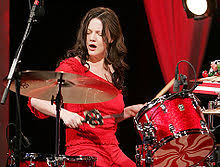
As a small child I can remember being very impressed with the Honeycombs - with their one hit 'Have I the Right?' - who had a female drummer (Honey Lantree). More recently female percussionists tend to be in all-girl bands, though you get the odd exception like Meg White of the White Stripes.

 More often the drummer is the less than pretty chap up the back, though Dave Clark contradicted this, not only by being good-looking, but also by being the up-front leader of his band, the Dave Clark Five.Though not as good looking as the beautiful Carl Palmer, originally of The Crazy World of Arthur Brown, joined by Emerson and Lake to form E.L. and P. instead of Mitch Mitchell - who nearly joined them when Jimi Hendrix left The Experience for The Band of Gypsies. Mitchell worked for The Who just before the arrival of Keith Moon, the archetypal eccentric and exuberant drummer . There's a theory that Moon was the inspiration for the Muppet's Animal, though it was in fact Henson's friend  Steve Mitchell.

After the breakup of the Yardbirds, Jimmy Paige was searching for a new drummer, with a list that was rumoured to include Ginger Baker as well as Procul Harem's B.J. Wilson. Robert Plant bombarded Bonham with telegrams, and he decided to accept their offers rather than Joe Cocker's and Chris Farlowe's as he preferred their music. He died aged 32 after drinking forty shots of vodka during rehearsals. Led Zeppelin disbanded out of respect for his family.

  Def Leppard went from strength to strength when their drummer lost an arm. Rick Allen joined the band when only 15, but just as the band were making a breakthrough, he lost his arm in a car crash. The band didn't consider a replacement, but supported him as, with a modified drum kit, and using his legs to do what his arms had previously, he retrained himself initially with the backup help of Jeff Rich. His fans call him 'The Thunder God'.

Although Ginger Baker was seen as rock's first superstar drummer and the inventor of the drum solo, pioneering the use of double bass drums, he prefers to see himself as a jazz drummer, though he also has influenced world music. For Charlie Watts, touring with the Stones pays the bills, but jazz was his first love, and he has a jazz band, the Charlie Watts Orchestra. Neil Peal (Rush) was originally influenced by Moon and Bonham, but later emulated jazz drummers such as Gene Krupa and Buddy Rich.  Josh Freeze (Nine Inch Nails) has possibly the most experience in every style of music.

 Ringo joined the Beatles late, replacing Pete Best after meeting the band in Hamburg. His unusual turns of phrase, or 'Ringoisms', such as  a Hard Day's Night, were often used in their songs; he sang in at least one song per album to establish the vocal personality of all four:  However he saved his only drum solo as a Beatle for the last song on their final album. Ringo was the moderator in band arguments.

Not so Stewart Copeland, he reputedly had Sting's name on his drums in the later years of Police, so he could beat the living daylights out of it. Copeland formed Police with Sting after the demise of his previous band, Curved Air. Early track lists were mostly his compositions; later they were mainly by Sting. Post Police he has composed several film scores.

After Peter Gabriel left Genesis, drummer Phil Collins filled the gap as best as he could without resorting to the outlandish costumes of Gabriel. The first album with Collins as main vocalist, 'The Trick of the Tail', could almost refer to the man in the background moving into the foreground. To help ease his change to vocalist, Bill Bruford of Yes stood in for touring. Collins's first solo albums recounting the pain of his recent divorce touched a chord - 'Face Value' was an international success.

But Dave Grohl had a more impressive transformation, starting out as Nirvana's drummer, now the lead singer, guitarist, main composer and founder of Foo Fighters. Mind you, the guitar was his first instrument originally, converting to drums in an early band called Mission Impossible. He has also worked as a session drummer for Bowie, Paul McCartney, Nine Inch Nails, Garbage, Tom Petty and others.


Thursday, 1 November 2012

Glad, bad, mad and sad

Is pop music really getting gloomier? A recent article in the Indy suggested so, listing happy songs of the 1960s, such as 'Daydream Believer' by the Monkees, 'She Loves you' by the Beatles, 'Shout' by Lulu - well, she may have been happy but it didn't exactly fill everyone else with joy did it? They could have included 'Glad all over' by the Dave Clark Five! Now glad is a word you don't often hear nowadays.

But apparently psychologists have recently shown that hit songs have become progressively sadder in the last half a century of pop music, analysing 1000 songs and showing that with each passing decade they have become more reflective and sombre. To contrast the two decades:

1960s: 85 per cent of  songs in a major key, 116 beats per minute;
2010s: just 42 per cent in a major key, 100 beats per minute.

The report suggests it's because people nowadays think they are smart, and happy music is a cliche. Life's more complicated, and we want our music to reflect that.

So the pattern goes: 1960s: carefree; 1970s: Abba kitsch; 1980s: Wham and glam;1990s: Grunge's angst;
2000, post-millenium tension of Radiohead and co.

All I can say is that Tears for Fears' (that's a pretty pessimistic name for a band if ever I heard one though their original name was History of Headaches) 'Mad World' reached no 3 in the charts in 1982, but when it was used by Michael Andrews in the Donnie Darko soundtrack, sung by Gary Jules  and given a much slower pace and lashings of melancholy it was a Christmas number one in 2003. It's a mad world and it's getting madder......

Wednesday is Indigo Blue

Possibly up to four per cent of the population, when seeing the number five, also see the colour red, although many have this condition but don't realise. And the  percentage might go up to 20 - 25 per cent among artists but it's also more common in women and among people who are left handed.There are over 60 types of synesthesia. In number form synesthesia numbers or letters are seen as coloured. For example, according to Marian McPartland, the jazz musician who is a synesthete,  'the key of D is daffodil yellow, B major is maroon, and B flat is blue.'

In ordinal linguistic personification, numbers, days of the week, months of the year  evoke personalities. In spatial-sequence, or number form synesthesia, numbers, months of the year and/or days of the week have precise locations in space.

The science of it: Synesthesia is a neurological condition in which stimulation of one sensory or cognitive pathway leads to automatic involuntary experiences in a second sensory or cognitive pathway. Or in simple terms, synesthetes involuntarily link one sensory perception to another. It runs in families, but can also be the result of a stroke, deafness or blindness. Some scientists believe it's a kind of cross-wiring, that we all possibly have it at birth but later lose it.

Famous people who may have had synesthesia are  the painter Vasily Kandinsky, the composer Franz Liszt, the poet Arthur Rimbauld and the physicist Richard Phillips Feynman.

In  'Wednesday is Indigo Blue' (2009), neurologist Richard E. Cytowic and neuroscientist David M. Eagleman introduce research on this condition.

Art of the camera: Art Kane

Art Kane, born Arthur Kanofsky, was a fashion and music photographer through the fifties to the nineties, til he committed suicide aged 69. As a new freelance photographer working for Esquire, he assembled  jazz musicians in the fifties to take probably the most well-known photo  in the history of jazz, known as 'A Great Day in Harlem'. That was just the start of his career photographing the famous. But to him performance shots were a waste of time. He said 'you have to own people... twist them into what you want to say about them.'  Andy Warhol reckoned that his work was 'usually a dramatic interpretation of personality.' His photos could be provocative and were sometimes rejected by magazines for irreverence.

In the sixties he turned to fashion and celebrity portraiture, pioneering the use of wide-angle lens for  close-up portraiture, and using deeply saturated colour.

He photographed The Who, Cream, The Rolling Stones, Bob Dylan, The Doors, Aretha Franklin, Janis Joplin, to name a few, but always in interesting situations: he said he wanted to interpret the human scene rather than simply record it.

All the Greats in A Great Day in Harlem

Art Kane, a freelance photographer working for Esquire, didn't have use of a studio when he took his famous photo of the 57  famous jazz greats he had managed to assemble in a street in Harlem at the unearthly hour (for jazz musicians) of 10 in the morning, on August 12, 1958.A documentary called A Great Day in Harlem, was made in 1994. Those present included Count Basie, Art Blakey, Dizzy Gillespie, Coleman Hawkins, Thelonious Monk, Gerry Mulligan, Charlie Mingus and Lester Young.

Only four remain living: Sonny Rollins, Horace Silver, Marian McPartland and Benny Golson.

Sonny Rollins was born 7th September 1930 and grew up in Harlem. He began as a pianist, moving first to the alto then tenor saxophone, trying to emulate his idol Coleman Hawkins; in the fifties he played with Miles Davis and Thelonious Monk, earning a reputation as a brash, creative saxophonist, a legend to the younger players.Over the years he has taken sabbaticals to study yoga and meditation.In the 1970's and 1980's he became interested in funk rhythms. His 2000 album 'This is What I do'  won a 2001 Grammy Award. Obama awarded him a National Medal of Arts in 2010.Horace Silver was born 2nd September 1928; his father was from Maio in Cape Verde, his mother was of Irish/African descent. His most famous tune, Song of My Father (Cantiga Para Meu Pia) has a flavour of his childhood days. He began as a tenor sax player but turned to the piano, and is best known for his pioneering contributions to hard bop. He was discovered by saxophonist Stan Getz, and in the fifties worked at the jazz club Birdland. He formed the Jazz Messengers, a jazz co-operative, with Art Blakey. He is one of the few jazz musicians to record almost exclusively original material.

Marian McPartland was born 20th March 1918, and played piano from the age of three. Having studied classical music at the Guildhall School of Music and Drama, she dismayed her parents when she became interested in American Jazz, and such musicians as Fats Waller,  Duke Ellington and MaryLou Williams. She joined a vaudeville act, touring Europe and entertaining troops during WWII. After a long association with Concord Jazz Label, she started her own label, Halcyon Records, in 1969.As she knows more songs than most jazz musicians, and knows more jazz musicians than most jazz musicians, she became  the host of Marian McPartland's Piano Jazz on radio until 2011. She was awarded a Grammy, a Trustees' Lifetime Achievement Award in 2004. Just before she was 90 she composed and performed 'A Portrait of Rachel Carson', a symphonic piece commemorating the centenary of the author of 'Silent Spring'.

  Benny Golson was born in Philadelphia on January 25th 1929. He has recorded over 30 albums and written over 300 compositions, including tv and film scores. He played with other promising musicians while still at High School: John Coltrane and Red Garland to name a couple. In the fifties he played with the Jazz Messengers, and Dizzie Gillespie's band. In 2004 he made a cameo appearance in the film 'The Terminal' , related to his appearance in the 'A Great Day in Harlem' Photo. In 2009 he was inducted into the International Academy of Jazz Hall of Fame.

Art Kane,the photographer of A Great Day in Harlem died in 1995 aged 69.

Portrait - Josephine

Josephine, full name Josephine Oniyama, has her debut album out at last at the ripe age of 30, along with a couple of stunning videos. Entitled Portrait, it's already attracting fantastic reviews - 'A timeless, distinctive, soulful voice': Music Weekly; 'a voice of striking clarity, soulfulness and originality':Guardian .Josephine herself writes on Twitter 'I try to SEE the things around me; I write about these things'. In the title track, Portrait,  she sings 'We are what we saw on tv, when we were tiny', talking of which, her tv debut was on Jools Holland last week. I missed it, but just happened to spot her in the album reviews in the paper. She's touring with Paloma Faith, and has some dates with Rodrigo y Gabriella. I'll be looking out for her in my area!